"Irish Hedgerow Laws — What You Can and Can't Do"
Hedgerows are the backbone of the Irish landscape. They shelter livestock, mark boundaries, filter water and — critically — provide habitat for nesting birds, pollinating insects and hundreds of native plant species. They are also one of the most legally protected features on your land. Get the timing or method of cutting wrong and you could face fines of up to fifty thousand euro, lose your CAP payments, or both.
Here is what the law actually says, what it means in practice, and how to stay on the right side of it.
The Wildlife Act: The Core Protection
The primary legislation protecting hedgerows in Ireland is Section 40 of the Wildlife Act 1976, as amended in 2000, 2010 and most recently by the Wildlife (Amendment) Act 2023.
The law is clear: it is an offence to cut, grub, burn or otherwise destroy any vegetation growing on uncultivated land, or any hedge or ditch, during the bird nesting season. The closed season runs from 1 March to 31 August inclusive — a full six months of the year.
Penalties are significant. On summary conviction, you face substantial fines. On conviction on indictment, penalties can reach up to fifty thousand euro and/or imprisonment for up to two years.
There are limited exemptions. Local authorities can cut hedgerows during the closed season where necessary for road safety — for example, to maintain sight lines at junctions. There is also a narrow exemption for destruction "in the course of agriculture" where no reasonable alternative exists, but this is interpreted strictly. The vegetation must be genuinely obstructing necessary agricultural work, and there must be no other practical option. This is not a general licence to cut hedges in summer.
The 2023 amendment strengthened these protections further. It clarified that hedgerow cutting during the nesting season by public bodies, including local authorities, is only permitted for reasons of public health or safety. The amendment also bolstered the broader protective regime for biodiversity by giving specific statutory recognition to the Minister's responsibilities in promoting the conservation of biological diversity.
The Heritage Act 2018: The August Derogation
The Heritage Act 2018 introduced a controversial provision under its Section 7 — a pilot scheme that would have allowed limited hedge cutting along roadsides during the month of August. The derogation was framed as a two-year trial aimed at giving farmers more flexibility around roadside maintenance.
Conservation organisations, including BirdWatch Ireland and the Irish Wildlife Trust, opposed the measure strongly. Many bird species are still nesting in August, and cutting during that month risked destroying active nests.
In practice, the pilot was never activated. The government dropped plans to implement the August cutting trial in 2019, and it was not brought into force before the provision's window expired. The full March-to-August closed season remains intact, and the 2023 Wildlife Act amendment effectively closed the door on any weakening of the nesting season protections.
The Roads Act 1993: A Competing Obligation
Here is where things get complicated for landowners. Section 70 of the Roads Act 1993 places a duty on landowners and occupiers to ensure that hedges, trees and other vegetation along public roads do not obstruct or endanger road users. Local authorities can serve notice requiring you to cut back vegetation that impairs visibility or encroaches on the road.
This creates a real tension with the Wildlife Act closed season. You are legally required to keep roadside hedges safe for traffic, but you are also prohibited from cutting them for six months of the year. The practical solution is straightforward: do your roadside maintenance during the open season, between September and February, so you never find yourself caught between the two obligations. If a genuine road safety emergency arises during the closed season, the local authority — not you — should carry out the work under their statutory exemption.
ACRES, GLAS and Agri-Environment Scheme Requirements
If you are in ACRES (or were previously in GLAS), your hedgerow management is subject to additional, specific rules that go beyond the Wildlife Act.
Typical requirements under these schemes include:
- Minimum hedge height: hedgerows generally cannot be cut below 1.5 metres.
- Unsprayed margins: a strip along the base of the hedge must be left unsprayed and uncultivated.
- Cutting rotation: hedges should be cut on a two- to three-year cycle rather than annually, and in some cases only one side per year.
- No removal: you cannot remove hedgerows that are part of your scheme commitments.
These requirements are designed to maintain hedgerows as functioning habitat — not just lines on a map. ACRES pays for leaving uncultivated margins alongside hedges, recognising the biodiversity value of the base vegetation where wildflowers, grasses and ground-nesting species thrive.
GAEC 8 and Cross-Compliance Under CAP
Under the current CAP (2023-2027), all farmers receiving Basic Income Support for Sustainability (BISS) payments must comply with Good Agricultural and Environmental Condition (GAEC) standards. GAEC 8 requires a minimum share of agricultural area devoted to non-productive features — and hedgerows are one of the key landscape features that count.
While the EU's 2024 Simplification Regulation relaxed the obligation to set aside a percentage of arable land for non-productive areas, it retained the ban on removing landscape features including hedgerows. You cannot remove hedgerows without permission, and cutting during the bird nesting season remains prohibited under GAEC cross-compliance.
The consequence of non-compliance is financial: removing hedgerows or cutting during the closed season can trigger reductions or complete loss of your CAP payments. Given the value of BISS and eco-scheme payments, this is not a risk worth taking.
EIA Agriculture Regulations
For larger-scale land restructuring, the Environmental Impact Assessment (Agriculture) Regulations add another layer. Removing hedgerows above certain thresholds — particularly as part of field amalgamation or restructuring of holdings — requires screening for Environmental Impact Assessment. You must obtain consent from DAFM before removing significant hedgerow. This applies regardless of the time of year and is separate from the Wildlife Act protections.
Best Practice: What This All Means on the Ground
The law sets the boundaries. Best practice goes further. If you want healthy, productive hedgerows that support wildlife and keep you compliant with every scheme and regulation, here is what to do:
- Cut between September and February only. This is the legal window, and it is also when cutting causes least ecological harm.
- Use a clean cutting method. A flail or circular saw gives cleaner cuts than a chain-type cutter. Clean cuts heal faster and reduce the risk of disease entering the hedge.
- Do not cut every year. A two- to three-year rotation allows hedges to flower and fruit, providing food for birds and pollinators. Annual flailing produces thin, gappy hedges over time.
- Consider laying rather than flailing. Traditional hedge laying rejuvenates old, leggy hedges far more effectively than mechanical cutting. It produces a dense, stockproof barrier and dramatically increases the habitat value.
- Leave the base vegetation. The margin at the foot of a hedge is some of the most valuable habitat on any farm. Tussocky grasses, nettles and wildflowers in this strip provide nesting cover for birds, overwintering sites for insects, and forage for pollinators.
- Think of hedgerows as corridors. They connect patches of habitat across the landscape — woodland to meadow, field margin to riverbank. A well-managed hedge network is a functioning ecosystem, not just a boundary.
Why This Matters for Wildflower Planting
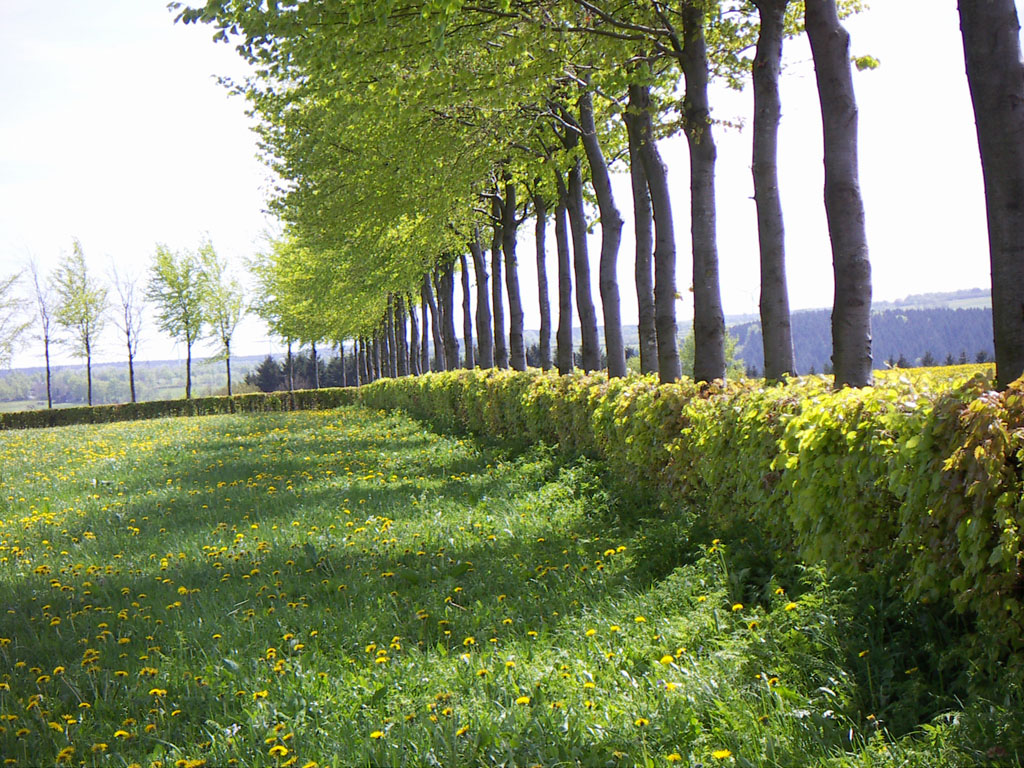
Hedgerow base margins are one of the best places on any farm to establish native wildflowers. The sheltered, undisturbed strip along a hedge provides exactly the conditions that species like foxglove, red campion, primrose, wild garlic and hedge woundwort need to establish and spread.
If you are in ACRES, you are already being paid to leave these margins uncultivated. Adding a native wildflower seed mix to those margins turns a compliance requirement into a genuine biodiversity gain — and the pollinators that forage on those wildflowers will use the hedge itself for nesting and shelter. It is a system that works together.
Hedgerows and wildflower margins are not separate habitats. They are two halves of the same thing. Get the hedge management right, sow the right seed at the base, and you have a corridor of life running through your farm.
Browse our native hedgerow wildflower mixes — developed for Irish conditions and designed to thrive in the sheltered margins where your hedgerows meet the field.