The Marsh Fritillary — Ireland's Only Legally Protected Butterfly
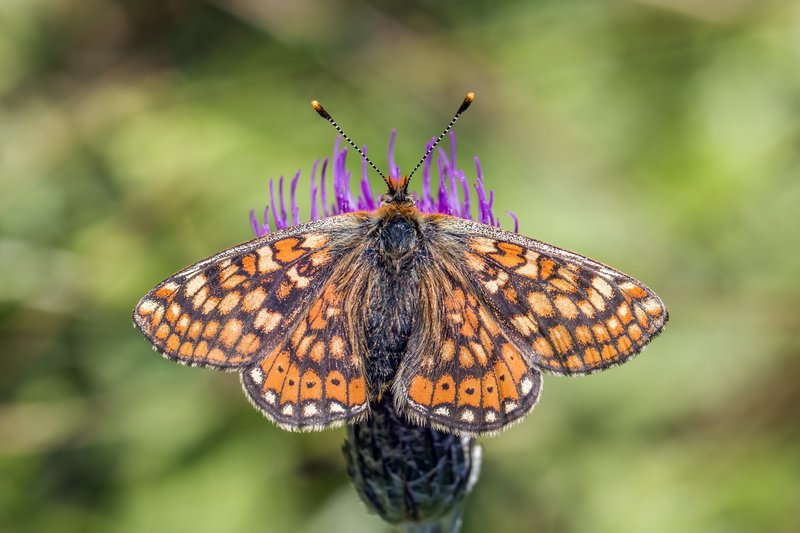
If you have ever walked along the edge of a bog in the west of Ireland on a warm day in late May, you may have seen it. A butterfly with wings like a stained-glass window — chequered panels of burnt orange, chocolate brown, and pale cream, edged in dark lines. It moves low over the grass, landing on purple flower heads, never straying far from home.
This is the Marsh Fritillary (Euphydryas aurinia). It is beautiful, it is declining across Europe, and it is the only butterfly in Ireland with full legal protection.
Why One Butterfly Got Its Own Law
Most Irish butterflies are protected in a general sense — you shouldn't go around netting them — but the Marsh Fritillary has a level of legal protection that no other Irish butterfly carries. It is listed under Annex II of the EU Habitats Directive, which means EU member states are required to designate Special Areas of Conservation (SACs) specifically for it. It is protected under the Irish Wildlife Act. And it is listed under the Bern Convention on the Conservation of European Wildlife.
That is a lot of legal weight for a butterfly that fits on a fifty-cent coin.
The reason is simple: the Marsh Fritillary is in serious trouble across its entire European range. Populations have collapsed in the Netherlands, Belgium, and large parts of England. Ireland, particularly the western counties of Clare, Galway, Mayo, and Kerry, holds some of the most important remaining populations on the continent. What happens here matters internationally.
A Life Built Around One Plant
The Marsh Fritillary's story is really a story about Devil's-bit Scabious (Succisa pratensis). This single wildflower is the only larval food plant for the species in Ireland. Without it, there are no Marsh Fritillaries. It is that absolute.
In late May and June, the adult butterflies fly for just a few short weeks. Females lay their eggs in large batches — sometimes 200 or more at a time — on the underside of Devil's-bit Scabious leaves. They are choosy about it, too. They prefer large, robust plants growing in sheltered spots within damp grassland.
When the caterpillars hatch, they stay together. They spin a communal silk web over their food plant and feed gregariously through the summer and into autumn. As the days shorten, they hunker down inside the web and overwinter as a group, tiny caterpillars huddled together against the Irish winter.
In spring, the surviving caterpillars emerge, disperse, and feed individually on fresh Devil's-bit Scabious growth before pupating in the grass tussocks. A few weeks later, the adults emerge, and the cycle begins again.
It is an extraordinary life history. But it also means the species is utterly dependent on one plant, in one type of habitat, with very specific conditions.
The Habitat It Needs
Marsh Fritillaries are butterflies of wet places. Damp grasslands, bog margins, wet meadows, and the fringes of lowland blanket bogs — these are the landscapes where Devil's-bit Scabious thrives and where the butterfly has its strongholds.
These are not the lush, improved pastures of modern Irish farming. They are the in-between places. The soft ground at the edge of a bog. The rushy field that was never worth draining. The damp meadow at the bottom of a hill where water collects and the soil stays poor. In ecological terms, they are extraordinarily rich. In agricultural terms, they have often been seen as marginal.
That tension — between what is ecologically priceless and what is economically marginal — is at the heart of the Marsh Fritillary's struggle.
A Population That Flickers
One of the most fascinating aspects of the Marsh Fritillary is its metapopulation structure. Unlike a robin or a wren that holds a territory year after year, Marsh Fritillary colonies blink in and out of existence. A colony might thrive on a particular patch of damp grassland for five or ten years, then crash — wiped out by a parasitic wasp, a bad winter, or a change in grazing pressure.
That is normal. It is how the species has always worked. The key is that when one colony crashes, another is establishing itself on a nearby patch of suitable habitat. The population survives not as a single group in one place, but as a shifting network of colonies across a landscape.
This only works if there are enough habitat patches, close enough together, for butterflies to move between them. When habitat is fragmented — when the wet meadows are drained, the bogs are cut away, and the connecting grasslands are reseeded — the network breaks down. Colonies crash and there is nowhere for the next generation to go.
What Threatens the Marsh Fritillary
The threats are painfully familiar to anyone who cares about Irish biodiversity:
- Drainage of wet grasslands and bog margins destroys the habitat where Devil's-bit Scabious grows
- Overgrazing by sheep or cattle can eliminate the scabious plants and destroy the caterpillars' silk webs
- Undergrazing is equally damaging — when grazing stops entirely, scrub and coarse grasses encroach and shade out the low-growing wildflowers the butterfly depends on
- Habitat fragmentation isolates colonies from each other, breaking the metapopulation network that the species needs to persist
- Peat extraction and land reclamation continue to eat away at the bogland margins that are core habitat
The irony is that the Marsh Fritillary evolved alongside traditional Irish farming. Light grazing by cattle, the kind of extensive management that kept rough pastures open without destroying them, was exactly what the butterfly needed. It was intensification on one hand, and abandonment on the other, that caused the problems.
What Helps
The National Parks and Wildlife Service (NPWS) monitors Marsh Fritillary populations and manages several SACs where the species is a priority. Conservation programmes focus on maintaining appropriate grazing levels on key sites and restoring habitat connectivity between colony patches.
But conservation is not only a job for government agencies. Anyone with land on or near bogland margins in the west of Ireland can contribute. The single most important action is to maintain or restore populations of Devil's-bit Scabious in damp grassland. That means:
- Keeping wet corners wet — resist the urge to drain marginal land
- Maintaining light grazing or an annual late-summer cut on damp meadows to prevent scrub encroachment
- Avoiding fertiliser and herbicide on rough grassland where scabious grows
- Planting native wildflower seed mixes that include Devil's-bit Scabious on suitable ground
Devil's-bit Scabious and Our Bogland Mix
Devil's-bit Scabious is a tough, long-lived perennial. It gets its common name from the abruptly truncated rootstock — as if the devil himself bit off the end. It flowers from July to October, producing round purple heads that are magnets for bees, hoverflies, and butterflies of all kinds. But for the Marsh Fritillary, it is not just a nectar source. It is everything — the nursery, the larder, and the winter shelter, all in one plant.
Our Bogland Pollinator Support Mix includes Devil's-bit Scabious specifically because of its critical role for this species. The mix is designed for damp, acidic soils — the bog margins, wet meadows, and rushy pastures where the Marsh Fritillary makes its home. It also includes other native wildflowers suited to these conditions: Ragged Robin, Meadowsweet, Wild Angelica, and Purple Loosestrife, creating a rich mosaic of forage across the season.
If you have damp ground on the edge of a bog, at the bottom of a hill, or along a watercourse in the west of Ireland, you may already have Marsh Fritillary habitat. Sowing Devil's-bit Scabious into it could be one of the most meaningful conservation actions you ever take.
A Butterfly Worth Fighting For
The Marsh Fritillary is not just a legal curiosity or a box on a conservation checklist. It is a genuinely stunning insect, a living indicator of healthy wet grassland, and a species for which Ireland carries an international responsibility. Its survival depends on the persistence of landscapes that were once considered worthless — the soft edges, the damp margins, the boggy corners that modern agriculture forgot.
Those landscapes are still out there. And with the right seed in the ground, they can sustain one of Ireland's most remarkable butterflies for generations to come.
Ready to create habitat for the Marsh Fritillary? Browse our Bogland Pollinator Support Mix and give Devil's-bit Scabious a home.