Why Irish Provenance Wildflower Seed Matters
Walk into any garden centre in Ireland and you'll find wildflower seed mixes on the shelf. The packaging shows meadow cranesbill, ox-eye daisies, maybe a bumblebee or two. It looks the part. But turn the packet over, and the story often changes. The species list — if there even is one — reveals cornflowers, Californian poppies, and other plants that have no business in an Irish meadow. The seed itself was likely harvested in the Netherlands or Eastern Europe, from cultivated varieties bred for colour, not for ecology.
If you're sowing wildflowers to support Irish pollinators, this distinction matters more than you might think.
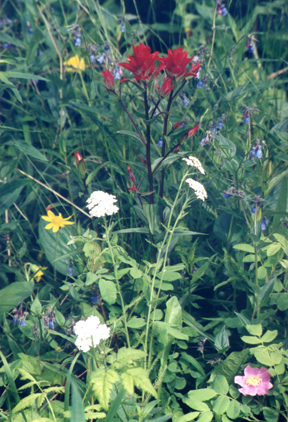
The Problem With Imported "Wildflower" Mixes
The majority of wildflower seed sold in Ireland is imported. Much of it comes from continental Europe or North America, where large-scale seed production keeps prices low. These mixes typically fall into two categories:
Non-native species mixes contain plants like cornflowers, field poppies, and corn marigolds. These are colourful, fast-growing annuals — but they're arable weeds, not meadow flowers. They'll put on a show in year one and largely vanish by year two, leaving bare ground or, worse, aggressive non-native species that outcompete whatever native plants were trying to establish.
Native species, foreign seed is a subtler problem. A mix might list species that are genuinely native to Ireland — bird's-foot trefoil, red clover, yarrow — but the seed was grown in the Netherlands or Denmark. The species is correct, but the genetics are wrong. More on that in a moment.
Both approaches undermine the ecological goal. If you're spending money and effort to create habitat for Irish pollinators, you want seed that actually fits the Irish landscape.
Ecotype: Why Genetics Matter
This is the part most people don't consider. A Red Clover plant growing wild in the Burren in Co. Clare is the same species as a Red Clover growing in a Dutch agricultural field. But they are not the same plant. Over hundreds of generations, the Clare population has adapted to local conditions — the thin limestone soils, the Atlantic rainfall, the day length at 53 degrees north, the particular temperature swings of a west-of-Ireland spring.
These locally adapted populations are called ecotypes. They flower at the right time for local pollinators. They're suited to local soil chemistry. They're resilient to the specific weather patterns of their home ground. When you sow Dutch-origin Red Clover in Co. Clare, you get a plant that may flower at the wrong time, grow at the wrong rate, or simply fail to thrive — and none of those outcomes help the bees that depend on it.
The same principle applies across every species in a wildflower mix. Native insects co-evolved with local wildflower ecotypes over millennia. Bloom timing, nectar production, and pollen availability are all finely tuned to match the activity patterns of local pollinators. Foreign ecotypes disrupt that synchronisation.
What "Irish Provenance" Actually Means
There are three levels of origin, and they're often conflated:
- Native species — the plant species occurs naturally in Ireland (e.g., ox-eye daisy, yellow rattle, devil's-bit scabious)
- Native seed — the seed is of a native species AND was produced in Ireland, but possibly from cultivated stock of unknown wild origin
- Native provenance — the seed descends from wild-collected Irish populations, maintained and multiplied under controlled conditions to preserve genetic integrity
Only the third category gives you true Irish-provenance wildflower seed. This is what you should be looking for.
DAFM Registration and Why It Matters
In Ireland, the Department of Agriculture, Food and the Marine (DAFM) maintains a seed certification system. DAFM-registered seed producers must meet standards for traceability, purity, and germination rates. This means every batch of seed can be traced back to its source, and the species composition is verified.
For wildflower seed specifically, DAFM registration matters because it provides independent oversight. You know the species list is accurate. You know the seed hasn't been bulked up with cheap filler. And you have a chain of custody from field to packet.
Ireland's leading native provenance seed producer is Design by Nature, trading as Wildflowers.ie, based in Co. Carlow. They collect seed from wild Irish populations across the country and multiply it on certified plots under DAFM oversight. This painstaking process — collecting from the wild, isolating ecotypes, building up stock over multiple growing seasons — is what separates genuine provenance seed from everything else on the market. It's also why it costs more than imported alternatives.
ACRES and Agri-Environment Scheme Compliance
For farmers participating in ACRES (Agri-Climate Rural Environment Scheme) or other agri-environment programmes, seed provenance is not just an ecological preference — it's often a compliance requirement. Many scheme actions that involve establishing wildflower habitat specify the use of certified native provenance seed. Using non-compliant seed can jeopardise payments and undermine the conservation objectives of the scheme.
If you're sowing under an ACRES plan, check the requirements with your advisor and make sure your seed supplier can provide documentation of provenance and DAFM registration.
How to Spot a Questionable Wildflower Mix
Not every brightly packaged seed mix is what it claims to be. Here are the red flags:
- No species list. If a mix is sold by weight alone with no breakdown of what's in it, walk away. You have no idea what you're sowing.
- Cornflowers, poppies, and other annuals marketed as "meadow mix." These are arable weeds. They're attractive but ecologically shallow and will not create a lasting meadow.
- No provenance information. If the seller can't tell you where the seed was grown or collected, it's almost certainly imported.
- Suspiciously cheap prices. Genuine Irish provenance seed is labour-intensive to produce. If a mix seems like a bargain, there's usually a reason — and that reason is foreign bulk seed.
- Vague language. Terms like "bee-friendly" or "pollinator mix" are not regulated. They sound good on packaging but guarantee nothing about what's inside.
What to Ask Your Seed Supplier
A reputable wildflower seed supplier should be able to answer these questions without hesitation:
- What species are in this mix? (Full list, with percentages by weight.)
- Where was the seed grown?
- What is the wild origin of the parent stock?
- Is the seed DAFM registered?
- Is this mix compliant with ACRES or other agri-environment scheme requirements?
If they can't answer, or won't, consider that a clear signal.
Our Commitment
At Pollinator Seeds, every wildflower mix we sell uses verified Irish-provenance native seed. We source from DAFM-registered producers who collect from wild Irish populations and multiply on certified plots. We publish full species lists for every mix. And we stand behind the ecological integrity of what we sell, because the whole point of sowing wildflowers is to support the insects, birds, and ecosystems that depend on them.
Ireland lost 97% of its wildflower meadows in a single generation — within living memory. Restoring even a fraction of that habitat is meaningful work — but only if the seed going into the ground is the right seed. Native species. Irish provenance. Verified genetics. That's the standard, and it's the standard we hold ourselves to.
Ready to sow with confidence? Browse our Irish-provenance wildflower mixes and see exactly what's in every packet.