"Sea Kale: The Forgotten Coastal Vegetable That Once Graced the Finest Tables"
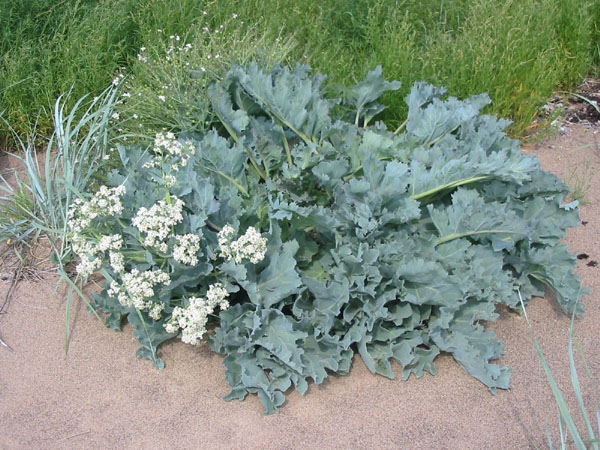
If you've ever walked along a shingle beach on the Irish coast in early summer, you may have seen it without knowing what it was: a handsome, low-growing plant with thick, blue-grey crinkled leaves and sprays of small white flowers that fill the air with the scent of honey. It looks ornamental. It looks tough. It looks like it belongs exactly where it is, wedged between the stones with the salt wind blowing over it.
That plant is sea kale — Crambe maritima — and it was once one of the most sought-after vegetables in these islands. For the better part of two centuries, it held a place of honour in the finest kitchen gardens in Britain and Ireland. Then, like so many heritage vegetables, it was quietly forgotten. The supermarkets couldn't sell it. The industrial farms couldn't scale it. And so a vegetable that had fed and delighted people for generations simply slipped out of sight.
It's time to bring it back.
A Victorian Delicacy
Sea kale is native to the Atlantic and North Sea coasts of Europe, and it grows wild on shingle beaches around Ireland, Britain, and as far south as the Bay of Biscay. For centuries, coastal communities gathered the young spring shoots as they pushed up through the stones. But it was in the eighteenth and nineteenth centuries that sea kale truly had its moment.
Georgian and Victorian kitchen gardeners discovered that if you covered the dormant crowns in late winter — using large upturned terracotta pots, often purpose-made with lids for checking progress — the emerging shoots would grow pale, tender, and sweet in the darkness. This technique, known as forcing, is the same principle used for rhubarb, and it transforms sea kale from a robust coastal plant into something genuinely refined. The blanched shoots were steamed and served with melted butter or a simple cream sauce, and they were considered a luxury on par with asparagus.
Grand estates had entire rows of sea kale under forcing pots. Seed catalogues listed multiple varieties. Cookbooks devoted pages to its preparation. It was, for a time, one of the most fashionable vegetables in the kitchen garden.
And then, slowly, it wasn't. The twentieth century favoured vegetables that could be harvested by machine, shipped long distances, and stacked on shelves in uniform rows. Sea kale — perennial, slow to establish, requiring the patience of forcing — didn't fit that model. It retreated to a handful of specialist growers and the memory of old gardening books.
What Does It Taste Like?
This is the question that matters, and the answer is worth getting excited about. Sea kale sits somewhere between asparagus and cabbage, which makes sense given that it belongs to the brassica family. The blanched, forced shoots are sweet and tender with a delicate, nutty flavour and just the faintest edge of bitterness — enough to make it interesting, not enough to make it challenging. The texture is crisp but yielding, somewhere between a thick asparagus spear and a tender broccoli stem.
But the forced shoots are only part of the story. Sea kale is one of those generous plants where almost everything is edible. The young spring leaves, before they toughen, can be cooked like cabbage or stirred into a gratin. The flower buds, picked just before they open, can be steamed and eaten like broccoli — and they're good, with a mild, sweet brassica flavour. Historically, even the thick roots were peeled, boiled, and eaten, though this isn't common practice today since it means sacrificing the plant.
Extraordinarily Hardy
Here is where sea kale starts to feel like a gift. This is a plant that evolved on exposed shingle beaches, battered by Atlantic gales, drenched in salt spray, growing in soil that barely qualifies as soil. It is, to put it plainly, extraordinarily tough.
Sea kale tolerates wind, salt, drought, poor soil, and cold winters without complaint. It laughs at conditions that would flatten most vegetables. If you garden on the coast, in exposed sites, or on thin, stony ground where other crops struggle, sea kale will thrive where little else will.
And it's a perennial. Plant it once, treat it reasonably well, and it will produce a harvest every spring for ten years or more. No annual sowing, no transplanting, no starting from scratch each season. It simply comes back, year after year, asking almost nothing of you except a bit of patience in the early years while it establishes its deep root system.
How to Grow Sea Kale
Sea kale is not difficult to grow, but it does have a few requirements worth understanding.
Soil and position. It wants well-drained soil above all else. Heavy, waterlogged clay will rot the roots. If your soil is on the heavy side, dig in plenty of grit, gravel, or sharp sand to improve drainage. A raised bed works well. Full sun is best — think of those open, south-facing shingle beaches where it grows in the wild.
From seed. Sea kale seeds have a hard coat and need a period of cold to break dormancy, a process called stratification. The simplest approach is to sow in autumn and let winter do the work for you — the natural cold period will trigger germination in spring. Alternatively, you can stratify seeds in the fridge: mix them with damp sand, seal in a bag, and refrigerate for four to six weeks before sowing in early spring. Germination can be slow and uneven, so be patient.
Establishment. Sea kale is slow to establish — it spends its first year or two building a deep, strong root system. Resist the temptation to harvest during this time. Let the plant put its energy into roots. By the third year, you'll have a robust crown ready for forcing.
Forcing and Harvesting
This is the rewarding part. In late winter, usually January or February, cover the dormant crown with an upturned bucket, large pot, or purpose-made forcing jar. The idea is to exclude all light. You can pack straw or fresh manure around the pot for warmth if you like — the Victorians often did — but it isn't strictly necessary.
Within a few weeks, the shoots will begin to push up inside the pot, growing pale and elongated as they search for light. When they reach about fifteen to twenty centimetres, cut them at the base with a sharp knife. These blanched shoots are your harvest — sweet, tender, and ready for the kitchen.
Don't force the same crown every year, or you'll weaken it. If you have several plants, rotate the forcing so each crown gets a year off to recover. This way, your sea kale patch will remain productive for many years.
Beautiful Enough for the Front Garden
Sea kale is not only a food plant — it's a genuinely beautiful ornamental. The large, blue-grey leaves are deeply crinkled and waxy, with a sculptural quality that catches the eye even in winter when they die back to reveal the sturdy crown. In early summer, the plant sends up dense clusters of small white flowers that are powerfully scented — a sweet, honey-like fragrance that carries on the breeze and draws bees in great numbers.
If you're looking for a plant that earns its place in the garden on looks alone while also feeding you every spring, sea kale is hard to beat.
A Conservation Story
There's an important reason to grow sea kale beyond the kitchen and the flower border. Wild populations of Crambe maritima are in decline across much of its range, including in Ireland. Coastal development, disturbance of shingle habitats, and over-collection have all taken their toll. In some areas, it's now legally protected.
Growing sea kale at home is a small but meaningful act of conservation. Every plant in a garden is a population maintained, a gene pool preserved. And if you let some of your plants flower and set seed — which the bees will thank you for — you're helping to keep this species robust and genetically diverse for the future.
Plant It Once, Eat for a Decade
Sea kale is one of those rare plants that gives you almost everything: beauty, fragrance, wildlife value, historical fascination, and a genuinely delicious crop — all from a single planting that asks very little of you in return. It connects us to centuries of kitchen garden tradition, to the coastal landscapes of Ireland, and to a way of growing food that values patience and permanence over convenience and uniformity.
It deserves to be remembered. More than that, it deserves to be grown.
Browse our Sea Kale Seeds | Explore our Heritage Seed Collection